Sand and Steel by Peter Caddick-Adams
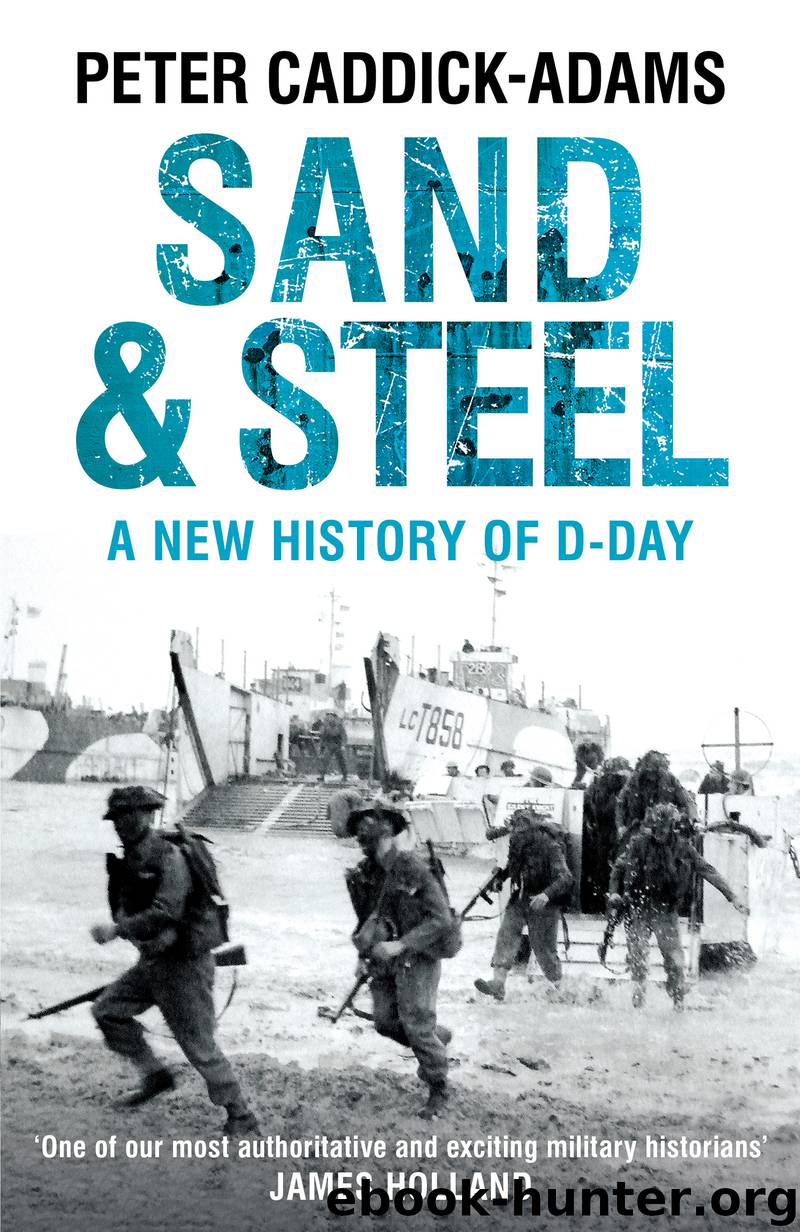
Author:Peter Caddick-Adams
Language: eng
Format: epub
ISBN: 9781473555112
Publisher: Random House
The experience of landing at Utah was uneven; some were barely engaged at all. Sergeant John Beck of the 87th Chemical Mortar Battalion, landing in a later wave, had been given a seasickness pill, ‘which made me feel better, and I dozed off only to wake with a start. We had reached the shore. There were about twenty-five yards of beach and then a levee about twenty-five feet high. The crew had brought us right in; we got out into water waist-deep. The cold water helped bring us back to reality.’64 British signaller Arthur McNeil aboard LCT-2440 remembered the LCTs of his flotilla forming ‘a line abreast for the run in; we were quite proud of the fact that we gave our American friends a dry landing. The water barely touched their axles – the American officer on the bridge thanked us as he departed, remarking “it was quieter than their pre-invasion exercises”’ – perhaps a dark reference to the ill-fated Exercise Tiger.65
As a piece of primary evidence, the ship’s log of LCT-645 goes some way to suggesting that to those present, Utah on 6 June 1944 seemed every bit as terrible as the world later knew Omaha to have been, and nothing like the ‘walkover’ the D-Day mythology suggests. Lieutenant Charles Summers, RNVR, commanding its British crew, noted leaving Dartmouth, Devon, the previous morning at 0430 hours, ‘loaded with six half-tracks towing anti-tank guns, ten Jeeps and seventy GIs’. A day later, he recorded at 0415 off the French coast: ‘a constant stream of aircraft, bombers, fighters, gliders’, replaced at 0630 by ‘an ear-splitting bombardment with smoke covering the coastline’. Five hours later, having left their line of departure for the beach, ‘an LCI coming off the beach about a cable’s length on our starboard beam [one tenth of a nautical mile], strikes a mine and sinks. There is no time to pick up any possible survivors.’ As they beached with the twenty-fourth wave at 1400, their passengers appeared nervous at disembarking in three foot of water and had to be coaxed ashore, with the result that the tide ebbed and the craft had to wait until 1900 hours, before floating off.
In the meantime the log, written the same day, recorded, ‘Utah beach looks a shambles with broken-down tanks, burning and exploding vehicles of all kinds due to enemy mortar and 88mm gunfire, although the beached landing craft appear undamaged. Sub Lieutenant Wyatt and my coxswain examine two other abandoned LCTs: one is full of corpses wrapped in blankets.’66 Harper Colman, with Company ‘H’ of the 8th Infantry, echoed this: ‘The history books claim this was one of the easier landings. It did not seem good at the time. We went into water more than waist-deep. Our first casualty was just behind me with a serious wound to the stomach. A second man, in front of me, stepped on a land mine. Our squad of six was down to four very early.’67
There is another apocryphal tale that surfaces in
Download
This site does not store any files on its server. We only index and link to content provided by other sites. Please contact the content providers to delete copyright contents if any and email us, we'll remove relevant links or contents immediately.
Waking Up in Heaven: A True Story of Brokenness, Heaven, and Life Again by McVea Crystal & Tresniowski Alex(37950)
Still Foolin’ ’Em by Billy Crystal(36500)
Cecilia; Or, Memoirs of an Heiress — Volume 1 by Fanny Burney(32754)
Cecilia; Or, Memoirs of an Heiress — Volume 2 by Fanny Burney(32115)
Cecilia; Or, Memoirs of an Heiress — Volume 3 by Fanny Burney(32097)
Fanny Burney by Claire Harman(26753)
Empire of the Sikhs by Patwant Singh(23226)
We're Going to Need More Wine by Gabrielle Union(19246)
Hans Sturm: A Soldier's Odyssey on the Eastern Front by Gordon Williamson(18738)
Plagued by Fire by Paul Hendrickson(17561)
Out of India by Michael Foss(17044)
All the Missing Girls by Megan Miranda(16845)
Cat's cradle by Kurt Vonnegut(15592)
For the Love of Europe by Rick Steves(15005)
Pimp by Iceberg Slim(14825)
Molly's Game by Molly Bloom(14296)
Bombshells: Glamour Girls of a Lifetime by Sullivan Steve(14245)
Leonardo da Vinci by Walter Isaacson(13551)
4 3 2 1: A Novel by Paul Auster(12647)
